
THE ENNEAGRAM
The Enneagram – more than a personality system
The Enneagram is a powerful framework for understanding human behaviour, emotional patterns and the deeper motivations that shape how we experience ourselves, others and the world around us.
While often described as a personality system, the Enneagram goes far beyond labels or categorisation. At its core, it explores the unconscious strategies we develop in order to feel safe, valued, loved, in control or protected — often from a very early age.
Over time, these strategies become so familiar that we begin to mistake them for who we are.
The way we think.
The way we react.
The roles we play.
The patterns we repeat.
The stories we tell ourselves about life, relationships and identity.
What may once have helped us navigate the world can eventually begin to limit us.
The Enneagram offers a way of bringing these patterns into awareness.
Not to judge ourselves, but to understand ourselves more honestly.
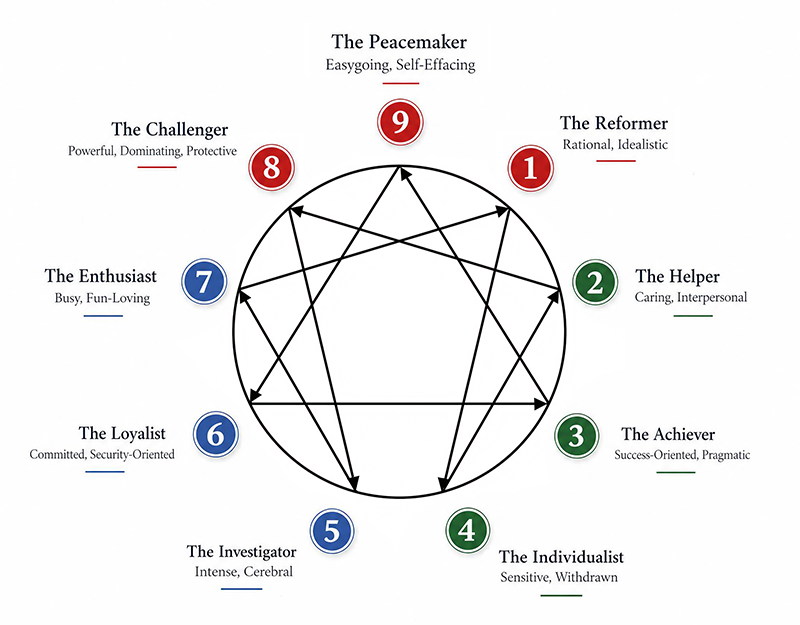
A Map of Human Experience
The Enneagram consists of nine core personality structures, each reflecting a different way of perceiving, interpreting and responding to life.
Each type carries:
- strengths,
- blind spots,
- fears,
- emotional habits,
- defence mechanisms,
- and deeper longings.
No type is better or worse than another.
Each represents a different adaptation to the human experience — a different strategy for navigating life, relationships and the search for meaning.
Yet beneath these strategies often lies something deeper:
a more authentic, grounded and fully alive version of ourselves that can become obscured beneath conditioning, expectation and survival patterns.
The purpose of the Enneagram is not to place people in boxes.
It is to help us understand the boxes we may already be living inside unconsciously.
Why I Use the Enneagram in My Work
I use the Enneagram as a practical and transformative tool for self-awareness, emotional understanding and personal growth.
It helps reveal:
- recurring relational patterns,
- unconscious motivations,
- emotional reactions,
- coping strategies,
- inner conflicts,
- and the ways we may disconnect from ourselves without even realising it.
Through this work, we begin to see more clearly:
- what is rooted in fear,
- what is rooted in conditioning,
- and what reflects a more authentic expression of who we are.
This creates the possibility for meaningful change.
Not through self-rejection or endless self-improvement, but through greater honesty, awareness and understanding.
The goal is not to become a “better personality type.”
The goal is to develop a more conscious relationship with ourselves — and from there create more authentic relationships, choices and ways of living.
Beyond Knowledge
Understanding the Enneagram intellectually is one thing.
Living it is something else entirely.
Real transformation occurs when insight moves beyond the mind and becomes emotionally understood, embodied and consciously integrated into daily life.
This is why my work focuses not only on knowledge, but on the deeper process of self-inquiry, reflection and practical integration.
Because lasting change rarely comes from information alone.
It comes from learning to observe ourselves honestly, understand our patterns compassionately and live with greater alignment between what we know, feel and do.
The Invitation
The Enneagram does not ask us to become someone else.
It invites us to become more aware of who we have learned to be — and who we may be underneath those adaptations.
For many people, this work becomes the beginning of a deeper relationship with themselves, others and life itself.
Not through perfection.
But through awareness, responsibility and a more authentic way of living.